Car Wash Membership Pricing: How to Set Tiers That Actually Convert
A practical breakdown of how to structure and price unlimited wash club tiers so they convert retail customers and protect your margins.
 By Jordon ComstockSeptember 13, 20263 min read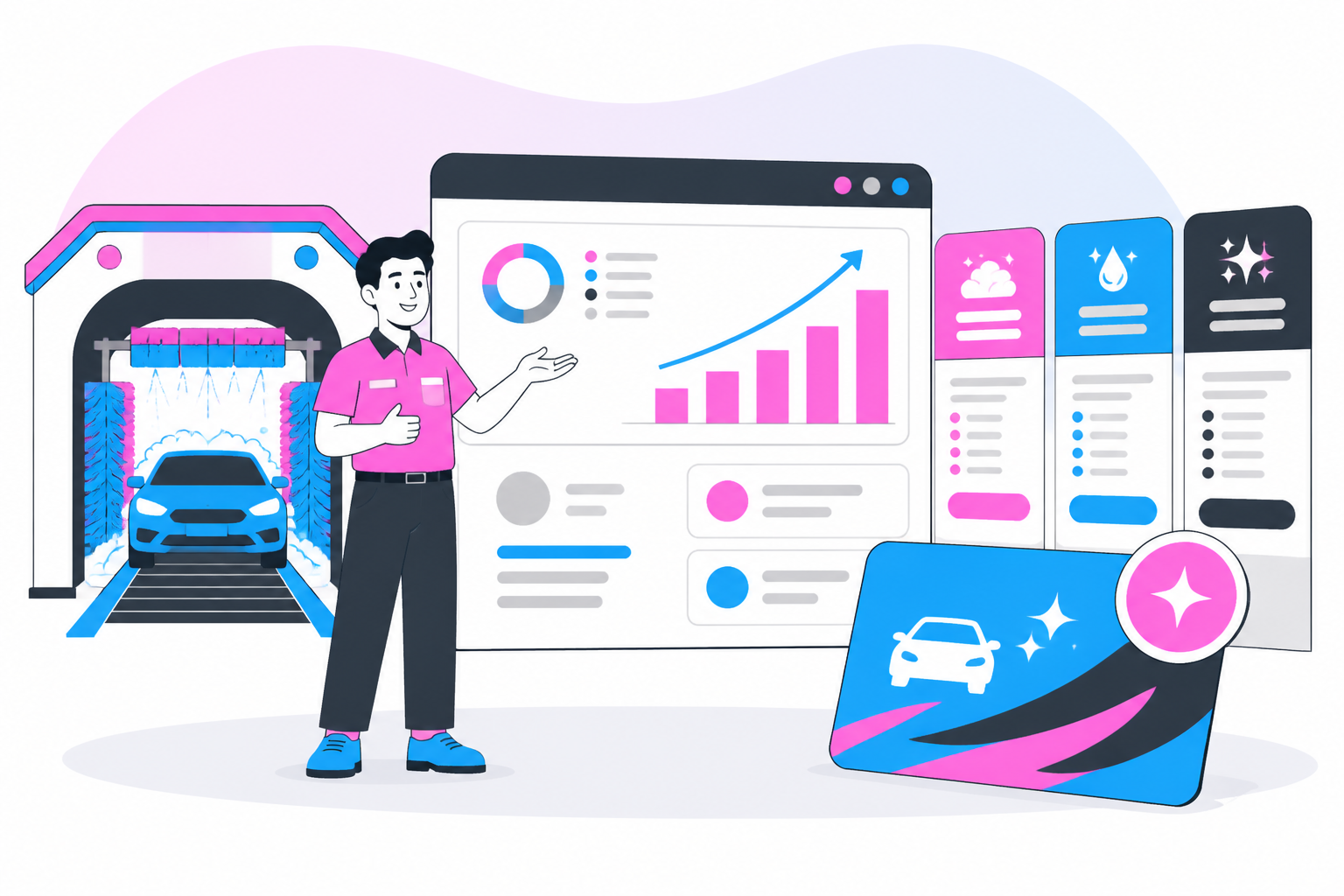
Pricing an unlimited wash club is part math, part psychology. Price too low and you'll attract heavy users who erode your margin on chemicals and water. Price too high and you'll struggle to convert single-wash customers into members at all. Here's how to think through it.
Start with your single-wash price as the anchor
Your monthly membership price should feel like an obvious upgrade compared to paying per visit. If your average single exterior wash sells for $12–$15, a membership priced so that just two visits a month pays for itself is an easy yes. As an illustrative example only, that might put your entry-level unlimited tier around $19.99–$24.99 a month — actual pricing should reflect your local market, chemical costs, and competitor pricing.
Build three tiers, not one
A single flat membership price leaves money on the table because it forces every customer into the same option regardless of what they actually want. A three-tier structure works better:
- Basic (example: $19.99/mo) — exterior wash, unlimited visits
- Premium (example: $29.99/mo) — adds wax, tire shine, undercarriage rinse
- Ultimate (example: $39.99/mo) — full chemical package, ceramic sealant, priority vacuum access
Operators consistently see the middle tier get the most signups when it's framed as the "most popular" or "best value" option — put a visual badge on it if your enrollment page supports one.
Price for your cost structure, not just the competition
It's tempting to just match whatever the wash down the street charges. Instead, work backward from your actual costs:
- Chemical cost per wash (varies by tier — top tiers use pricier product)
- Water and sewer cost per wash
- Estimated average visits per member per month (most washes see 3–6 for active unlimited members)
- Credit card processing and any billing platform fees
Multiply your estimated visits-per-member by your per-wash cost, then make sure your monthly price still leaves a healthy margin even for your most frequent members. This is why unlimited plans tend to price the top tier disproportionately higher — heavy users cluster there, and the extra revenue offsets the extra chemical use.
Consider household and multi-vehicle pricing
Adding a second vehicle to an existing membership at a discount (for example, $10–$15 more per month for a second car under the same plan) is a low-effort way to increase revenue per household without adding a new tier to explain at the pay station.
Don't discount your way into a bad program
Founding-member or launch-week discounts can help you build initial volume, but be careful about permanent discounting. A membership that's priced too low to begin with is hard to raise later without member pushback — and cancellations spike whenever prices change. It's easier to launch at a sustainable price and offer a short-term intro rate than to underprice from day one.
Where billing software fits in
Whatever tier structure you land on, you need a system that can actually manage multiple price points, apply the right plan to the right vehicle, run recurring billing automatically, and handle upgrades or downgrades between tiers without a manual invoice every time. BoomCloud's membership platform for car washes is built for exactly this — set your tiers once, and enrollment, billing, and plan changes run themselves for a flat platform fee, not a percentage of what you collect.
Review pricing at least once a year
Chemical and water costs move, and so does your local competitive landscape. Set a calendar reminder to review your membership pricing annually — track your cost-per-wash by tier and compare it against your actual monthly revenue per member to make sure the math still works. For the full framework on building a membership program from scratch, see our step-by-step membership playbook.
Getting pricing right up front makes every other part of the program — marketing, enrollment, retention — considerably easier.
