Salon Memberships vs. Packages: Which Actually Builds Recurring Revenue?
Salon memberships vs. prepaid packages: why packages are a promotion and memberships are a business model — and when to use each.
 By Jordon ComstockSeptember 11, 20265 min read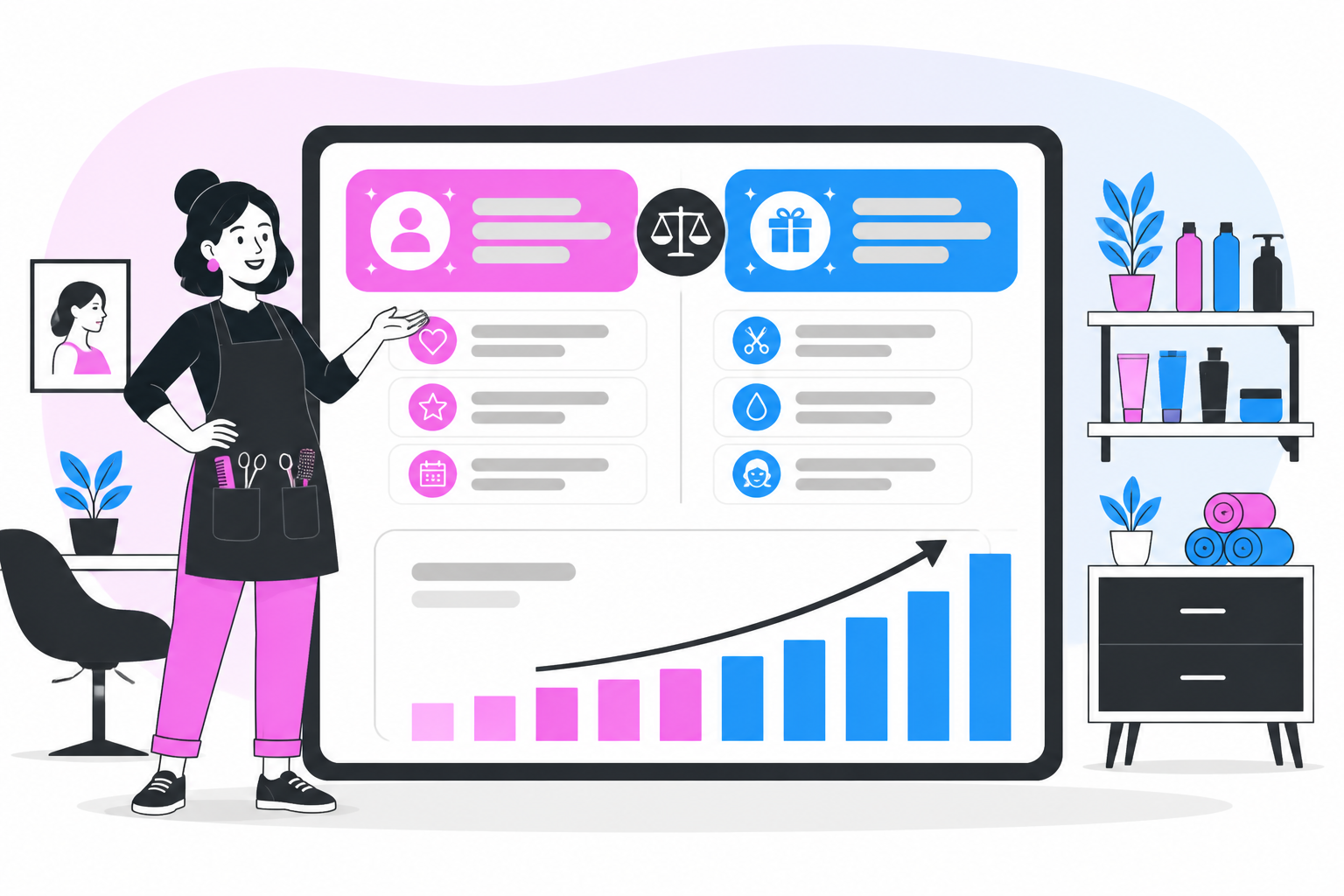
Most salon owners believe they already have recurring revenue because they sell packages. A client buys five blowouts and gets the sixth free, or prepays for a series of three deep-conditioning gloss treatments before summer. The transaction feels like loyalty, the cash registers immediately, and the appointment book fills up for the next few weeks.
When the idea of a membership program comes up, the standard response is almost always: "Isn't that just a package with more steps?"
It is not. The debate between a salon membership vs packages is not a matter of semantics. It represents two entirely different financial structures. A package is an episodic discount paid in advance. A membership is an ongoing service agreement paid automatically on a recurring schedule. One produces a temporary spike in cash that leaves you with uncompensated chair time weeks later; the other builds an operational baseline that protects your salon against seasonal slowdowns.
The Hidden Flaws of the Salon Package
On paper, prepaid packages look attractive. You collect $250 or $400 upfront, which provides an immediate cash injection into your bank account. However, looking past that first deposit reveals three distinct operational liabilities:
- The Deferred Labor Problem: When a client purchases a package of five appointments, you recognize 100% of the revenue on day one. But on visits three, four, and five, your stylists are consuming backbar product and occupying chairs without generating any fresh revenue. If you pay commission when the service is rendered, you must preserve that cash reserve weeks into the future. If you pay commission upfront, your stylists effectively work those subsequent appointments for zero immediate pay—a common point of friction on the salon floor.
- The Re-buying Friction: Every package has a built-in termination point. When the last service is rendered, the relationship resets to zero. Your front desk must initiate a brand-new sales conversation: "Would you like to buy another package today?" That gives the client an immediate reason to pause, check their budget, or consider trying another studio down the street. That silence at checkout is where client churn quietly happens.
- The Promotional Trap: Packages are almost universally structured around a discount (buy five, get one free). Over time, this conditions your best regulars never to pay full price for maintenance services, shrinking your profit margins on high-demand appointment slots.
The Mechanics of a Salon Membership
A membership flips the transaction from default-cancel to default-renew. The guest authorizes an automatic recurring charge to their card on file every month. In exchange, they receive a defined allocation of maintenance services and member benefits.
Consider an illustrative example: a salon owner selling an express blowout and gloss membership at $85 per month. The client receives two blowouts and 10% off retail products. The revenue drafts on the first of the month, whether the client books their visit on the 3rd or the 28th. If they do not use both blowouts, your program terms dictate whether they roll over or expire, but your revenue remains completely stable.
If that studio enrolls 100 members at $85 per month, the salon opens its doors on the first day of every month with $8,500 in predictable revenue already secured. That is money that covers rent, base payroll, or inventory orders before a single walk-in crosses the threshold or a single stylist picks up a pair of shears.
Direct Comparison: Salon Membership vs Packages
1. Cash Flow Timing
Packages: Create a feast-or-famine cycle. You experience strong sales weeks followed by weeks where your team delivers prepaid labor with no corresponding cash deposits.
Memberships: Deliver flat, predictable monthly deposits. This recurring predictability makes lease renewals, equipment upgrades, and payroll commitments straightforward because you are not relying solely on new appointment bookings to meet fixed overhead.
2. Client Retention
Packages: Expire by design. They require your front desk or stylists to actively resell the client multiple times per year, forcing an active purchase decision every few months.
Memberships: Continue automatically until the member actively cancels. The burden of action shifts: instead of needing to decide to stay, the member stays because their routine hair care is already automated.
3. Client Behavior and Retail Lift
Packages: Clients often treat package visits purely as transactions they have already paid for, making them more hesitant to add retail or add-on treatments at checkout.
Memberships: Members behave like insiders. Because their monthly service is handled on autopay, they do not feel the sting of a large bill at checkout. This makes them significantly more likely to purchase home-care retail, add a scalp treatment, or tip their stylist generously.
Structuring Services for a Membership Model
Not every service on your menu belongs in a subscription. High-touch, infrequent services—such as four-hour custom color corrections or full-set extensions—are difficult to package into a monthly fee because their timing and product costs vary wildly.
The ideal membership services are high-frequency, predictable, and routine:
- Blowout and styling clubs (one, two, or four visits per month)
- Single-process root touch-up and gray coverage programs (every four to five weeks)
- Gloss, toner, and conditioning maintenance between major highlight sessions
- Men's maintenance cuts and beard trims (every two to three weeks)
By focusing on maintenance services, your membership captures the predictable work clients already need to keep their hair looking consistent between major transformation appointments.
Can You Offer Both?
Yes, provided you understand their distinct operational roles. Packages should serve as customer acquisition tools, not your core business engine.
A package works well for a targeted, finite goal: a bridal prep bundle (three facials and three blowouts leading up to an event) or an introductory three-pack for a new guest to experience different stylists. Once that package concludes, your intake process should graduate that client into a monthly membership. The package introduces them to the habit; the membership maintains it.
To run this without creating an administrative nightmare at the front desk, you need proper billing infrastructure. recurring membership billing built for salons handles the recurring billing mechanics—including client enrollment, automatic recurring drafts, decline notices, automated retries for failed cards, and member payment reporting—so your front desk team does not spend their days tracking down expired credit cards or manually keying in transactions.
If you want a detailed breakdown of plan tiers, cancellation policies, and staff compensation models, review the step-by-step guidance in our salon membership playbook.
Moving Your Salon to a Recurring Model
Take an honest look at your appointment ledger over the past six months. Identify the maintenance services your regulars book on a strict schedule. Instead of waiting for those guests to call when their roots show or discounting service bundles to get fast cash, design a simple, recurring tier that automates the relationship. Building recurring revenue takes your business off the weekly booking rollercoaster and places it on a foundation you can actually forecast.
Written by
Jordon Comstock writes for BoomCloud™ on patient membership plans, recurring revenue, and reducing PPO dependence.