Family and Couples Memberships for Chiropractic Offices
How to build family and couples membership tiers in a chiropractic office — discount structure, when to offer them, and how to protect margin.
 By Jordon ComstockSeptember 11, 20265 min read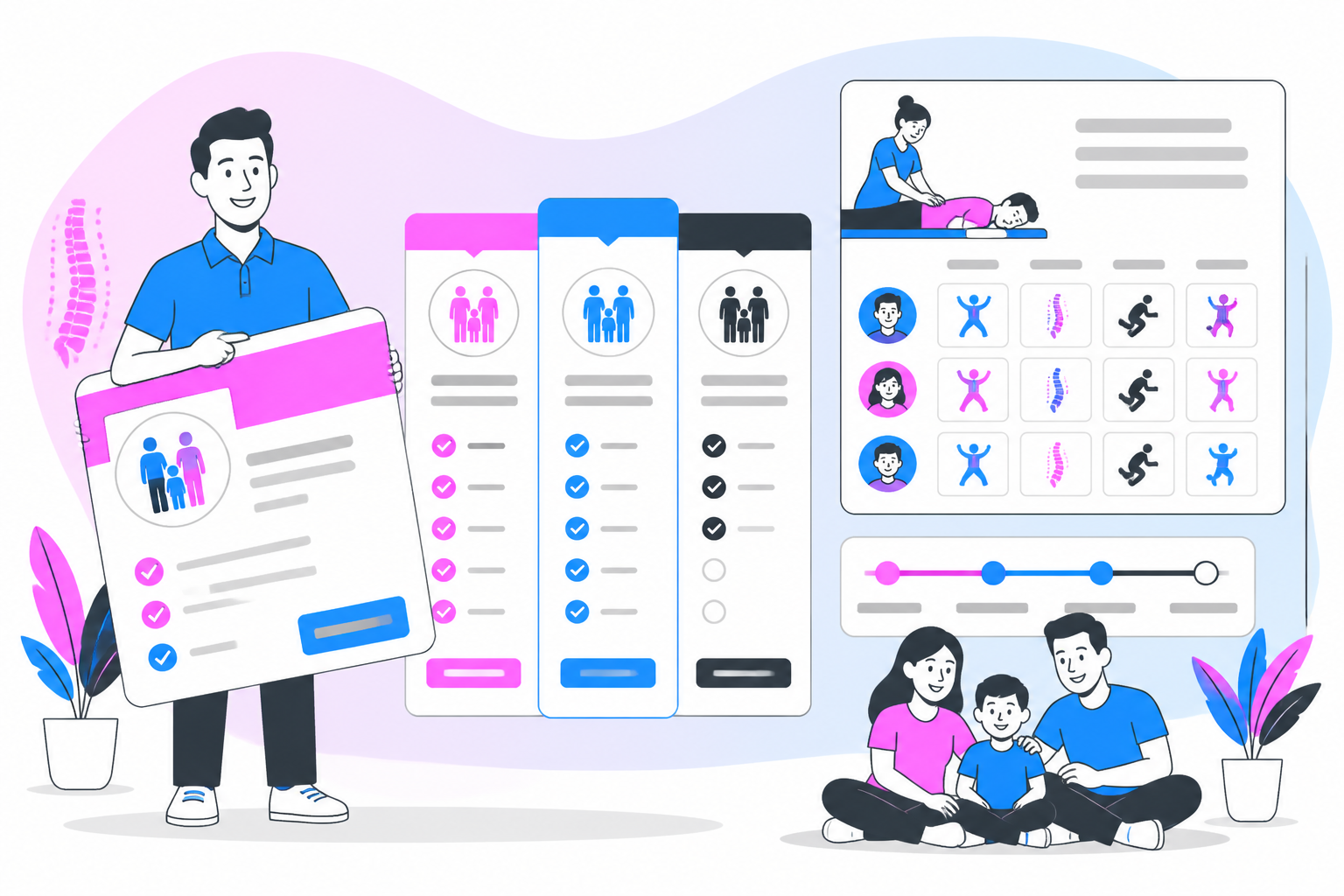
Most chiropractic offices leave substantial revenue on the table because they treat patient acquisition purely as a one-to-one interaction. An adult walks in with acute neck pain, completes an adjustment protocol, transitions to wellness care, and signs up for a recurring monthly membership. That is standard practice. The mistake happens right after: the front desk processes the single agreement and closes the file, completely ignoring the spouse and children sitting at home.
A chiropractic family membership is one of the highest-leverage tools available to a private practice. Your primary patient is already convinced of your clinical value. They trust your hands, they understand your care philosophy, and they have already overcome the mental hurdle of recurring out-of-pocket healthcare expenses. Adding a partner or dependent is a minor decision compared to that initial enrollment. Even better, household accounts consistently show higher lifetime value because families build health routines together.
The Retention Mechanics of Household Plans
Individual memberships are vulnerable to sudden life changes. If a single member experiences a busy work month, travels, or simply feels good for a few weeks without symptoms, their perceived need for regular adjustments dips. They start questioning whether their monthly charge is worth keeping. That is how quiet cancellations happen.
Households operate under completely different retention psychology. When two, three, or four people in a household are tied to the same plan, care rhythms become interdependent. If one spouse is having an easy month with zero back stiffness, the other might be dealing with a shoulder flare-up from yard work, or their teenager might need an alignment after soccer practice. The perceived utility of the plan never drops to zero.
Because the plan continues to provide value to someone under the roof, the entire household remains enrolled. This directly stabilizes your patient churn, which becomes clearly evident when you analyze your monthly numbers over a trailing six- or twelve-month period.
Structuring Tiers: Mental Math That Works
Complexity kills enrollment. If your front desk team has to open a spreadsheet or calculate custom percentages to tell a mother what it costs to add her two kids, you have built the wrong model. Keep the arithmetic so simple that a patient can calculate their total cost while standing at your checkout counter.
Avoid flat, catch-all "family passes" that allow unlimited visits for an entire household. Those packages invite schedule abuse and compress your profit margins to unsustainable levels. Instead, structure your chiropractic family membership using a primary-plus-dependent model:
- Primary Adult Member: Full price for your standard wellness tier (for example, $119 per month for up to two routine adjustments).
- Spouse or Partner Add-On: A predictable 25% to 35% discount off the primary tier rate (for example, $85 per month).
- Dependent Children (under 18 or 21): A flat, low-friction add-on rate per child (for example, $40 to $50 per month) with a clear scope of maintenance visits.
- Household Billing Rule: Exactly one monthly billing date, one credit or debit card on file, and one clean receipt sent to the primary account holder.
By discounting only the secondary and tertiary members, you preserve the perceived value of your base adjustment fee while creating genuine savings for the household. For a detailed breakdown on establishing baseline profit margins before setting discount tiers, consult our pricing guide.
Managing Capacity and Guarding Clinic Margin
The cardinal sin of family membership design is discounting the primary fee or offering shared, unmetered visit pools. If you sell a "family plan" with eight included visits per month shared among whoever wants to use them, you will inevitably have one high-utilization family member consuming seven visits while the others consume one, completely skewing your per-visit reimbursement.
Protect your operational capacity with strict, straightforward boundaries:
- Visits remain individual: Unused visits for a child do not roll over or transfer to a parent. Each member gets their assigned monthly allotment.
- Cap wellness visits per person: Define clearly that membership fees cover routine wellness adjustments, not extended therapeutic modalities, intensive rehab, or new injury examinations.
- Define clear upgrade paths: If a family member suffers an acute injury or requires active traction therapy, that clinical care is billed separately or discounted under a defined member-discount schedule, rather than absorbed into the monthly fee.
When you cap access clearly, your clinical schedule remains protected, and your revenue per chair-hour stays predictable as family enrollment expands.
When and How to Present the Plan
Do not rely on mass email marketing or passive lobby posters to grow your household memberships. Blast newsletters announcing new couples pricing rarely yield significant enrollments because the patient is not in a clinical mindset when reading promotional email.
The offices that consistently convert individuals into family accounts rely on one simple conversation during regular workflow moments. There are two distinct windows when this works best:
1. At Initial Care Plan Transition
When a patient finishes an acute care phase and transitions onto regular wellness maintenance, your front desk team presents their ongoing enrollment. This is the prime opportunity. The ask is simple and conversational: "We have you set up on the wellness plan starting today. Did you want to add your spouse or kids to this card so they get the household rate?" That single question turns an individual plan into a couples or family plan a significant percentage of the time.
2. During Wellness Check-Ins and Annual Reviews
When a patient mentions family activities, kids' sports injuries, or a partner's desk fatigue during their routine adjustment, the clinical team has an organic opening: "Bring him in on your family rate so we can check that lumbar strain before it turns into something worse." The recommendation comes from clinical concern, not sales pressure.
Setting Up the Billing Infrastructure
Administrative friction will strangle a family membership program if your front desk has to manually track who belongs to whom, split charges across different profiles, or re-run cards when a payment bounces. A professional household plan must operate on automated, reliable billing rails.
Using purpose-built BoomCloud membership software for chiropractic practices allows you to link multiple patient profiles under a single responsible billing party. When the primary member updates their card through a self-service portal, the entire household's billing details update automatically. If a card declines, automated payment retries and patient decline notifications handle the collection cycle without forcing your front desk staff into awkward payment conversations in the waiting room.
Furthermore, your signup pages should give patients the option to add household dependents directly when they register online. When a patient can select their primary membership and immediately add their spouse and children on the same enrollment form, adoption rates climb without consuming extra front desk time.
Taking Action on Household Memberships
If your practice already has individual members on recurring auto-debit, you already have your best prospect list. Look through your active roster, identify the patients who have previously mentioned partners or children, and train your front desk staff on the enrollment script this week.
If you are drafting your first membership tiers or overhauling an existing cash plan, walk through the structural steps in our launch playbook to ensure your fee structures, clinical boundaries, and automated billing are aligned for sustainable growth.
Grow the recurring side of your practice
- The chiropractic membership program playbook — tiers, pricing, enrollment, and billing, step by step.
- Chiropractic membership plans — how the plans work, what to charge, and where the revenue comes from.
- Chiropractic practice management — the operating system behind a growing practice.
- recurring revenue for chiropractic practices — turn one-time visits into monthly recurring revenue.
Chiropractic family plan software
To run a family plan, the practice creates a household tier in BoomCloud, enrolls each family member under one agreement, and bills the household on a recurring schedule. Clinical care stays in your EHR. See chiropractic membership software.
Written by
Jordon Comstock writes for BoomCloud™ on patient membership plans, recurring revenue, and reducing PPO dependence.